The night dive and the PhD: Dr Melanie Welfare on facing fear and finding her way back to Ara
14 August, 2026
Dr Melanie Welfare completed a PhD examining virtual reality in midwifery education - and returned to Ara to put the findings into practice
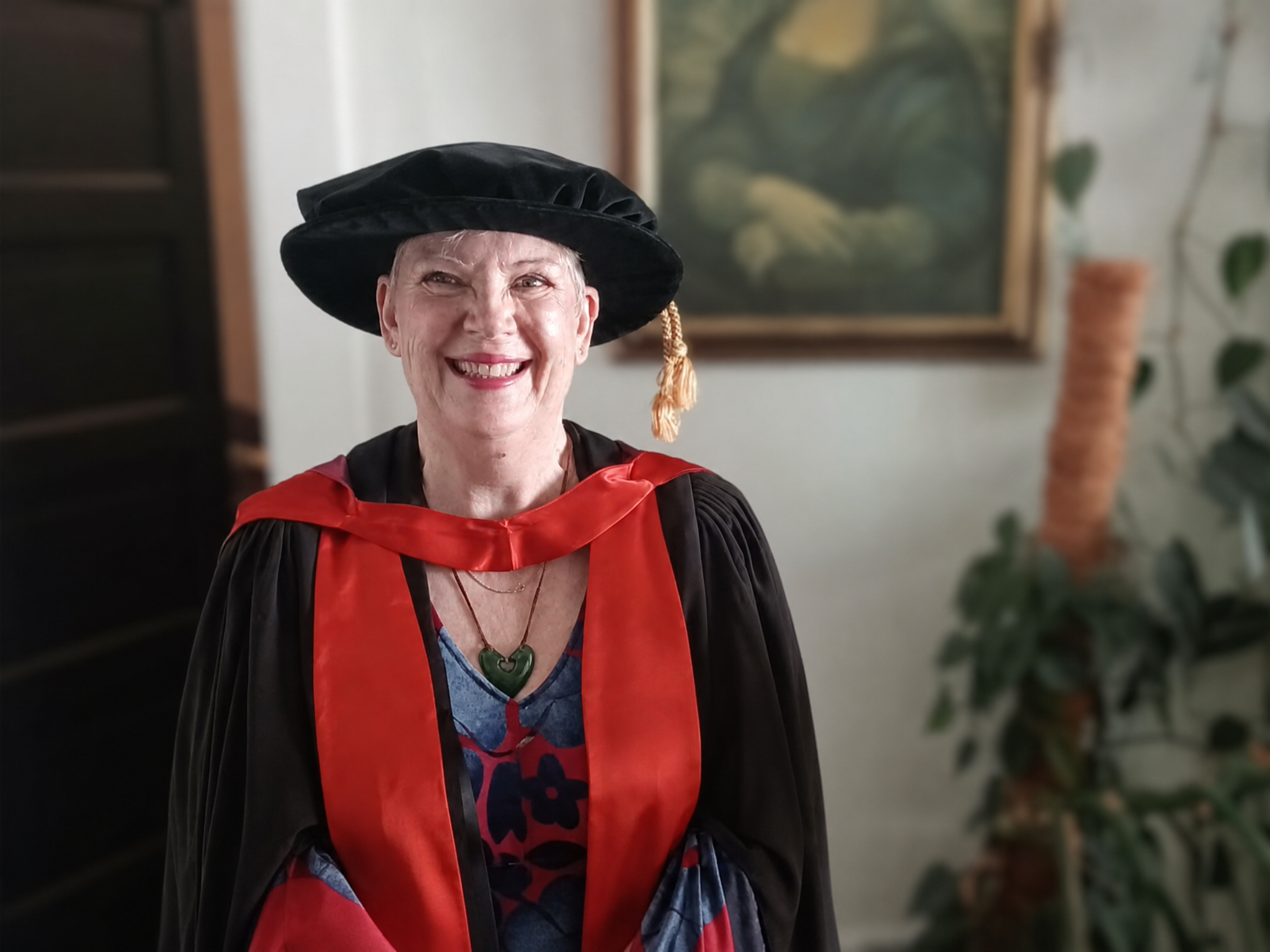
Ask Dr Melanie Welfare to name the scariest thing she's ever done, and her PhD oral defence makes the shortlist, right alongside a night dive with sharks on the Great Barrier Reef.
"That was right up there with the scariest things I've done in my life," she said of her oral defence, held at the end of May. It's a fitting comparison for someone who has spent her career finding the calm amid high-stakes moments, first as a nurse, then a midwife, and now a midwifery education researcher.
Dr Welfare’s route into midwifery started young. She began working in health at 17 as a nursing auxiliary, then became an army nurse with the British Army's Queen Alexandra's Royal Army Nursing Corps (QARANC), before training as a midwife at Bournemouth University in the late 1990s.
"I wanted to work with people," she said. "Nursing didn't give me the time to really be with people. Midwifery does. Having the time to be with women is what fills my cup."
She returned to Aotearoa in 2000 and spent 14 years working as a core, continuity and lead maternity carer (LMC) midwife, before moving into academia around 2010. Dr Welfare went on to spend close to a decade at Ara, including as Associate Head of Midwifery, before a move to Edith Cowan University in Perth, Australia, in 2023. This year, she returned home to Ōtautahi Christchurch and rejoined the Ara midwifery team.
In between, she completed a Master's degree at Victoria University of Wellington in 2018, examining the experiences of midwives who move between work settings, then started a PhD at Auckland University of Technology (AUT) in 2022 - a project that would take her through two more country moves, ongoing full-time work, and, she said, a broken foot that turned out to be one of the more useful things to happen along the way.
"Never underestimate the time a PhD takes out of your life," she said. "I had an excellent support network. Honestly, one of the best things that happened to me was breaking my foot; I couldn't work full-time, and it gave me the time to push through to the end."
Her PhD, published on 10 June, explored how midwifery students and educators experience using virtual reality (VR) as a teaching and learning tool. Using hermeneutic phenomenology, a methodology grounded in the philosophy of Heidegger and Gadamer, Melanie interviewed eight midwifery students and seven midwifery educators at one Aotearoa institute about their experiences.
The research surfaced two distinct but connected phenomena. For students, VR revealed what Dr Welfare calls "Seen and Unseen Pressure": the hidden weight students carry as they try to become "proper" midwives, able to manage any emergency that comes their way. For educators, it revealed something she terms "Expert Lens versus Novice Wonder": the instinct of experienced practitioners to step into VR scenarios as experts themselves, and the risk that this instinct can overshadow what students actually need from the experience.
"For students, VR surfaced pressures they put on themselves to be seen as a 'proper' midwife able to handle any emergency," she said. "For us as educators, it's harder than it looks to leave our expert eye at the door and see it through a student's eyes."
Her findings point to a clear implication for institutions introducing VR: good IT support, institutional buy-in and funding aren't optional extras, but part of what makes the technology work pedagogically rather than just technically.
Dr Welfare’s research hasn't slowed since submitting her thesis. She's currently part of several international VR collaborations: developing a tool with Australian colleagues to help clinicians in remote and rural areas diagnose and treat sepsis, contributing to a joint UK, Germany, Australia and New Zealand project comparing 2D and fully immersive VR teaching approaches, and working with Australian partners on a cervical dilation training tool. She has no plans for further formal study, but said simply: "I'll keep writing."
Getting through the PhD wasn't just a matter of time. "Imposter syndrome nearly stopped me three or four times," she admitted, "that belief, as a woman, at my age, that I could actually do it. My supervisors dragged me through it, kicking and screaming, some days." Her advice for anyone facing something similarly daunting borrows from an old saying: "Step by step. If you're going to eat an elephant, you start with the big toe."
Now back in front of students, Dr Welfare said that's exactly where she wants to be. Ara's midwifery programme, she said, produces graduates she'd back without hesitation. "If I had a business, I'd take an Ara midwife over anyone else."